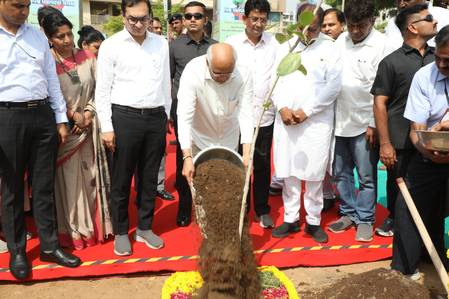
Agartala, June 6 (IANS) Tripura has taken a major step towards achieving self-sufficiency in the production of high-value mango varieties, with the State Horticulture Research Centre (SHRC) establishing an exotic mango block to assess the performance of premium varieties under the state’s agro-climatic conditions.
Agriculture and Farmers’ Welfare Minister Ratan Lal Nath said on Saturday that the initiative aims to evaluate the adaptability and yield potential of several superior mango varieties and lay the foundation for future expansion of quality planting materials in the state.
Inaugurating the Fruit and Vegetable Development Unit office building at SHRC, Nagicherra, the Minister said that the exotic mango block has been developed with several superior and high-value varieties, including Yellow Banana, Doc-Mai, Red Palmer, Bari-4, Brunei King, Haribhanga, Katimon and Thai-1 Red.
“The objective is to assess their performance, adaptability and yield potential in Tripura’s agro-climatic environment and to lay the foundation for future production and large-scale expansion of quality planting materials,” Nath said.
Describing the SHRC as one of Tripura’s premier horticultural research institutions, the Minister said that the centre undertakes both strategic and applied research on a wide range of horticultural crops, including fruits, vegetables, coconut, arecanut, cashew nut, spices and aromatic crops, potatoes through Apical Rooted Cutting (ARC) and Integrated Potato System (IPS) technologies, mushrooms, tissue culture and macro-propagation.
“The centre was initially established with the collection and introduction of germplasm of crops such as coconut, arecanut, red oil palm, cashew nut, pepper and banana,” he said.
Speaking about the Fruit Development Unit, Nath said that the fruit block, spread across nearly 15 hectares, possesses a rich collection of indigenous as well as exotic fruit crops and is making a significant contribution to horticultural research and development in the state.
He said the major objectives of the fruit block include the introduction, evaluation and popularisation of high-yielding, climate-resilient and market-oriented indigenous and exotic fruit varieties suitable for Tripura.
The unit is also engaged in the conservation, maintenance and evaluation of fruit germplasm to identify the most suitable varieties for the state.
“In addition, the centre is focusing on innovation and development of modern technologies to enhance productivity, quality, sustainability and profitability in fruit cultivation,” the Minister said.
He informed that winter strawberry cultivation is also being undertaken at the centre for commercial feasibility studies and demonstration purposes.
Highlighting the role of the Vegetable Innovation Unit, Nath said that the facility, located within the Fruit Block of the SHRC, has been established to develop and disseminate advanced vegetable production technologies aimed at improving productivity, profitability and sustainability in Tripura’s horticulture sector.
Among its key objectives is the promotion of off-season vegetable cultivation technologies, including summer cauliflower cultivation, among small, marginal and commercial farmers. Such initiatives enable farmers to supply vegetables during periods of high market demand and secure better prices and higher returns.
The Minister said the unit is also committed to the collection, conservation, evaluation and research utilisation of Tripura’s valuable indigenous germplasm, including Surji chilli, Bird’s Eye chilli and Shingaratha brinjal.
“Conservation of these invaluable genetic resources will not only preserve the state’s agricultural heritage but will also play a crucial role in future crop improvement and variety development programmes,” he said.
Nath further stated that efforts are underway to expand the cultivation of yellow-skinned watermelon as a high-value alternative to conventional red-skinned varieties, creating new market opportunities and enhancing farmers’ income prospects.
“Through the adoption of ARC technology, average potato productivity in Tripura has increased to 5,888 kg per hectare, which is nearly 90 per cent higher than the state’s earlier average productivity,” he said.
He further informed that during the last three years, 2023-24, 2024-25 and 2025-26, five new potato varieties, namely Kufri Moin, Kufri Himalini, Kufri Uday, Kufri Lima and Kufri Thar-12, have been introduced and cultivated in the state.
According to Nath, Tripura has set an ambitious target of becoming self-reliant in the production of high-quality potato seeds through ARC technology by 2028-29, thereby reducing dependence on seed supplies from outside the state.
“The government has also set a target of achieving complete self-sufficiency in ware potato production by 2029-30, which will further strengthen the state’s agricultural economy and enhance farmers’ livelihoods,” the Minister added.
–IANS
sc/dan