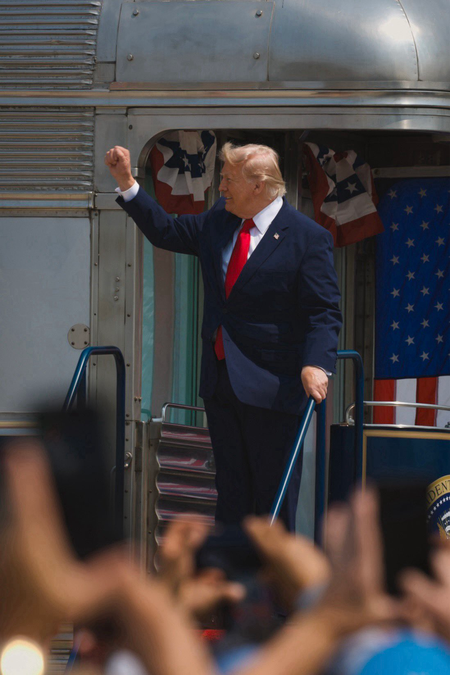
Washington, July 7 (IANS) President Donald Trump departed the White House on Monday evening (US time) for Ankara, where he will seek to press NATO allies to accelerate defence spending, strengthen burden sharing and expand defence industrial cooperation during this week’s alliance summit.
Trump is scheduled to arrive in the Turkish capital on Tuesday afternoon, where he will be greeted by Turkish President Recep Tayyip Erdoğan. He will participate in a State Arrival Ceremony and Honour Guard review before holding bilateral talks with Erdoğan.
On Tuesday evening, Trump will attend the NATO Leaders’ Social Dinner. On Wednesday, he will join the official welcome and family photo before participating in the NATO Leaders’ working session.
He will later hold bilateral meetings with Ukrainian President Volodymyr Zelensky and Syrian President Ahmed al-Sharaa before holding a press conference and departing Ankara. Trump is scheduled to return to the White House on Wednesday evening.
Ahead of the trip, US Ambassador to NATO Matthew G. Whitaker said the Ankara summit would measure allies’ progress towards the defence spending commitments agreed at last year’s Hague summit, where NATO members adopted a benchmark of spending five per cent of gross domestic product on defence.
“President Trump expects all allies to step up immediately, and not only get on a sustainable path to the 5% but get to 5% as soon as possible in a very dangerous world that needs capable allies,” Whitaker said.
Travelling with the President are Secretary of State Marco Rubio, Treasury Secretary Scott Bessent, Defence Secretary Pete Hegseth, White House Deputy Chief of Staff Dan Scavino, Deputy Chief of Staff Stephen Miller, Communications Director Steven Cheung, Counsellor Mike Needham and White House Staff Secretary Will Scharf.
Whitaker said NATO allies had committed nearly $139 billion in additional defence spending since the Hague summit, with “roughly half of that being on American-made equipment and weapons and munitions.”
“That’s a good start, but some allies are doing more than others,” he said, pointing to Poland, the Nordic countries and the Baltic states as leading the effort, while noting that Germany was on track to reach the target by 2029.
He said the summit would also review how allies were expanding NATO’s military capabilities and strengthening defence production on both sides of the Atlantic.
“We expect all allies to demonstrate meaningful upward trajectories, both quantitatively and qualitatively, in defence spending that results in a fair burden sharing,” Whitaker said. He added that NATO members needed to invest at speed in both traditional defence systems and innovative technologies to meet evolving security challenges.
Whitaker said Washington’s goal remained to shift more responsibility for Europe’s conventional defence to European allies and Canada.
“The United States remains a proud NATO member,” he said. “But we have responsibilities elsewhere in the world, as the world’s only superpower. We need to be able to not only project power worldwide, but we also need capable allies that can join us and be interoperable, and also add to our power.”
White House Principal Deputy Press Secretary Anna Kelly said the administration viewed the summit as another step in reshaping the alliance.
“Under this President’s leadership, the United States has initiated a fundamental and historic shift in the structure of NATO, moving the alliance from a model of dependency on the United States to one of real burden sharing and self-reliance,” Kelly said.
She added that allies would discuss procurement frameworks to expand defence capabilities and ways for American companies to accelerate and showcase their products across the alliance.
–IANS
lkj/rs