Milwaukee, Oct 2 (IANS) The United States is pursuing a “managed trade relationship” with China rather than expecting fundamental changes to Beijing’s economic system, US Trade Representative Jamieson Greer said, as he detailed a new mechanism aimed at insulating some trade from future tensions between the world’s two largest economies.
Greer said decades of US experience had shown that China’s economic system was closely connected to its political system and was difficult to change.
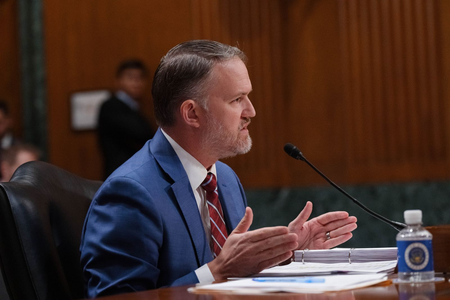
“Our view over the past decades of American experience with the Chinese is their economic system, which is not a market-based system. It’s closely tied to their political system, which makes it very difficult to change,” Greer told reporters after the G20 Trade Ministers’ Meeting in Milwaukee.
“Obviously we welcome, market-based changes in China. We think that makes sense, but at the same time, they are going to have their policies and we, we need immediate action to balance our relationship with the Chinese,” he said.
Greer said President Donald Trump had therefore chosen a different approach.
“So the president, very appropriately has decided to have a managed trade relationship with China, and we have seen that become very effective,” he said.
Greer pointed to the US goods trade deficit with China as evidence of the shift.
“Our trade deficit with China and goods coming into the Trump, second Trump administration was $300 billion. Right now, today, we’re on track for $140 billion trade deficit annualized for this year. So that’s a big change,” he said.
“That’s more than 50 per cent,” he added.
Greer also offered details about the US-China Board of Trade, a mechanism inaugurated following a recent meeting between Trump and Chinese President Xi Jinping.
On the US side, Greer said, the mechanism involves the Office of the US Trade Representative and the Treasury Department.
The two sides have each selected about $30 billion worth of goods that could form a more stable foundation for bilateral trade, he said.
“And together, we have each chosen about $30 billion worth of goods on each side, goods that are non-sensitive, goods that we think we can trade a little more freely, goods that we don’t want to be used as leverage in any trade measures that might happen in the future,” Greer said.
He made clear, however, that the mechanism was not intended to eliminate broader US-China trade tensions.
“Because to be sure, there will continue to be trade friction between China and the United States,” Greer said.
Washington instead wants to manage the relationship while maintaining protections involving sensitive sectors and areas affected by practices it considers unfair.
“There’s going to be protection, as long as there are unfair trading practices in China, there’s going to be protection here, but that doesn’t mean we can’t have a foundation and balanced in the relationship, for these other things,” he said.
Greer said the Board of Trade covered about 30 per cent of US exports to China and about 10 per cent of Chinese exports to the United States.
Asked later about a timeline for tariff reductions under the mechanism, Greer replied: “No.”
He said future tariff or trade actions would have to go through US legal procedures, with the Board of Trade’s recommendations potentially considered as part of that process.
The United States and China have had a contentious trade relationship spanning tariffs, market access, subsidies, technology and industrial policy. The Trump administration has increasingly linked trade policy with domestic manufacturing, supply-chain resilience and economic security.
Greer’s remarks in Milwaukee came as G20 trade ministers discussed structural excess capacity, forced labour, food-related trade coercion and possible reform of the global trading system. The United States is serving as G20 president in 2026.
–IANS
lkj/rs