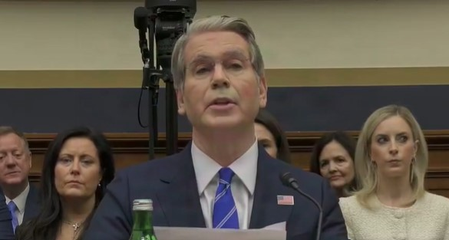
Washington, Oct 15 (IANS) US Treasury Secretary Scott Bessent has urged the International Monetary Fund to step up its scrutiny of “non-market policies and practices and exchange rates” and called the planned end of World Bank lending to China “an important milestone”.
The remarks on Wednesday (local time) came in a written statement from Bessent to the World Bank Development Committee and the IMF’s International Monetary and Financial Committee at the IMF-World Bank Annual Meetings in Bangkok.
“One area where this refocus must go further is in the IMF’s work on global imbalances,” the statement said.
“This especially includes strengthening its analysis and engagement on the role non-market policies and practices and exchange rates play in driving external imbalances,” it added.
The statement did not name any country in that passage. It said policymakers were having “difficult discussions about how to sustain market-based systems amid distortionary policies from some economies that skew competition and hurt employment”.
“The IMF was founded to prevent these kinds of distortive policies and negative spillovers, and must exercise its voice on this critical issue or risk being sidelined,” Bessent said.
On the World Bank, the statement said the lender should phase out sovereign lending to countries that have long met its graduation criteria.
“Despite being long overdue, the planned phase-outs of lending to China and Poland represent an important milestone for both countries,” Bessent said.
He said the Bank was entering “the longest period in its history without a country graduating from lending eligibility” and that its management “should take concrete steps to ensure that graduations resume”.
The statement also said the IMF “has sufficient resources to accomplish its mission”.
Bessent said the United States “remains committed to a strong, quota-based, and adequately resourced IMF” and was working to secure congressional approval for the 16th General Review of Quotas.
“Any future quota realignment should reflect members’ relative position in the world economy and be based on a new quota formula,” he said.
Bessent also called on the World Bank Group to “formally retire its prohibition on financing upstream gas and oil” and criticised IMF financing through the Resilience and Sustainability Trust that he said “veers into development-policy lending”.
The IMF and World Bank Annual Meetings are being held in Bangkok this week. The International Monetary and Financial Committee advises the IMF’s Board of Governors, while the Development Committee advises the World Bank and IMF boards on development issues.
The IMF’s quota system determines each member’s financial contribution, voting power and access to Fund financing.
–IANS
lkj/sd/