Islamabad, Aug 15 (IANS) Islamabad risks not only destabilising Pakistan-occupied Kashmir (PoK) but also eroding its international standing if the Pakistani authorities continue to treat political dissent as terrorism. The Joint Awami Action Committee (JAAC) protests in the occupied territory serve as a warning that legitimacy cannot be manufactured through force, and that the voices of Kashmiris, both at home and abroad, cannot be silenced, a report has stated.
The summer of 2026 has exposed the deepening fragility of governance in PoK. What began as a grassroots movement demanding lower electricity tariffs and subsidised flour has evolved into a full-scale confrontation led by the Joint Awami Action Committee (JAAC), a coalition of traders, civil society groups and activists, according to a report in Eurasia Review.
Their demands have since broadened into an extensive 38-point charter, including a call to abolish the 12 Legislative Assembly seats reserved for refugees. The JAAC viewed these seats as a tool of Islamabad’s political influence and a barrier to genuine local representation, the report noted.
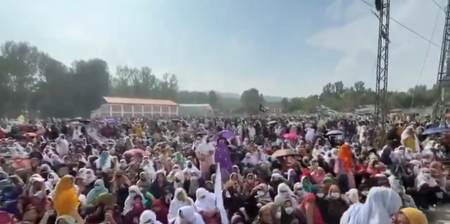
“When negotiations collapsed in June, Islamabad chose repression over dialogue. On 5 June, authorities declared JAAC a proscribed organisation under antiterrorism laws, suspended internet and mobile services, and announced regional elections for late July. Amnesty International condemned the move as a dangerous escalation, warning that antiterror legislation was being weaponised against a political protest movement. The crackdown reached its bloody climax in Rawalakot, where police and paramilitary forces attempted to disperse demonstrators,” Eurasia Review detailed.
According to the report, the deaths in Rawalakot have sent shockwaves well beyond PoK, prompting the Kashmiri diaspora in Britain to mobilise outside Pakistan’s diplomatic mission in London on June 9. A larger march followed on July 5, with thousands taking to the streets of central London and marching towards the Pakistan High Commission. Protesters called for the release of detainees, accountability for civilian deaths, and an end to the communications blackout.
The report highlighted that further solidarity actions in Bradford and outside the High Commission underscored the movement’s transnational reach. Across the Atlantic, the diaspora mobilisation also continued, with Kashmiri communities from Washington, DC, Maryland and Virginia staging a demonstration near the White House on July 11 and calling for international intervention.
Their demands were clear, namely, restoring communications, investigating protest-related deaths, and holding Islamabad accountable for human rights violations.
As unrest in PoK intensified, the protests by Kashmiri diaspora groups across the world continued in August, denouncing brutalities by Pakistani forces against peaceful protestors in PoK.
On Wednesday, several members of the Kashmiri diaspora in Belgium staged a protest march from the European Parliament to the United Nations office in Brussels, condemning the killings of innocent civilians by Pakistani forces in PoK.
The protesters raised slogans against Pakistani forces and called for international attention to ongoing human rights abuses in PoK, including restrictions on essential services and the brutal use of force against demonstrators in the occupied territory.
Recently, several British parliamentarians expressed grave concern over brutalities by Pakistani forces against civilians in PoK during the anti-government protests.
British Labour Party MP Liam Byrne said that reports of live fire being used against peaceful protesters in PoK are “deeply alarming.”
Calling the killing of civilians in PoK a “tragedy,” another British MP, Adnan Hussain, said that any use of excessive or unlawful force by Pakistani authorities must be subject to a full, independent, and transparent investigation.
–IANS
scor/ksk/as